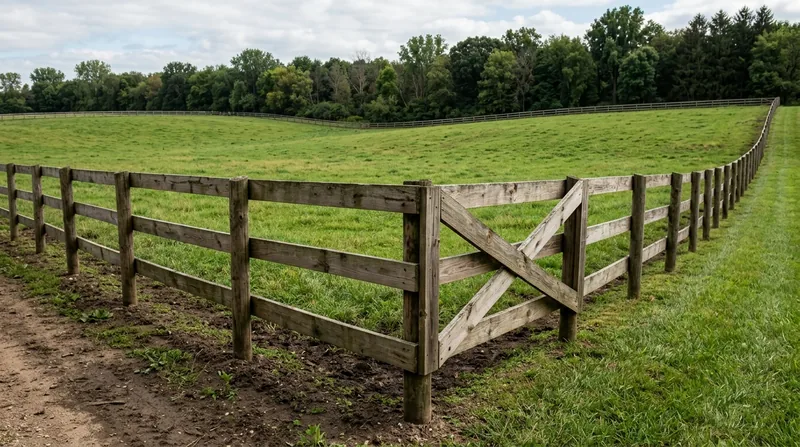




When you own acreage on the western or southern edges of the Chicago metro, keeping livestock contained and equipment moving through your property means building fencing that stands up to real work. Farm fence installation in Chicago requires more than just standard residential know-how: you need posts set deep enough to handle pressure from animals, gates that swing true under load, and materials that won't fail when the seasons turn. Chicago Fence Pros has built ranch and farm fencing since 2009 for property owners who need their perimeter to work as hard as they do. We work with split rail, no-climb horse fence, field wire, and pipe fencing on properties across the region. Whether you're fencing a small paddock or securing a multi-acre parcel, we handle the layout, the digging, the material selection, and the finish work so your fence does its job for years.
Why Farm and Ranch Fencing Matters on Chicago-Area Acreage
Residential fencing and farm fencing solve different problems. A backyard privacy fence keeps neighbors from looking in; a ranch fence installation keeps livestock from getting out and predators from getting in. Posts must be spaced to resist animal pressure, materials must tolerate weathering and contact, and gates must be built to handle repeated opening and closing under load. On acreage in the Chicago region, you also face variable soil conditions, freeze-thaw cycles, and the need to coordinate with equipment access for pasture maintenance and hay delivery.
- Posts set in concrete foundation, spaced 6 to 8 feet apart depending on animal type and fence material, resist lateral pressure from livestock.
- No-climb horse fencing and field wire prevent animals from stepping through or catching legs, reducing injury risk.
- Pipe fencing and split rail withstand moisture and seasonal movement better than lighter residential materials.
- Proper gate installation and swing clearance allow equipment passage without binding or damage.
- Utility locates protect underground lines before any digging begins on your property.
Getting these details right from the start saves you repair costs and keeps your animals safe. Before work begins, call 811 for a free utility locate so we know where gas, electric, water, and telecom lines run across your property.
Key info: Illinois law requires a free utility locate (811) before digging any post holes on your property. We coordinate this as part of our site visit so no underground lines are damaged during installation. Contact your local Chicago building department to confirm setback and height rules for your specific property, as these vary by municipality and may be affected by deed restrictions or HOA rules.
For more information on permit requirements and local code in your area, visit the City of Chicago Department of Planning and Development website or contact your village or township administrator.
How We Install Farm and Ranch Fencing Near Chicago: Process and Materials
Every acreage is different. Some properties have mature trees that become natural fence posts; others are open field. Some owners need to contain horses; others are securing equipment storage or managing wildlife pressure. We start with a site walk to understand your terrain, identify utilities, check for existing surveys, and talk about what the fence needs to do. Then we give you a detailed estimate that covers materials, labor, gate hardware, and timeline.
- We locate and mark your property line based on your existing survey, and you confirm the fence placement before we break ground.
- We call 811 for a free utility locate and wait for the marks to be painted before we dig any post holes.
- We set posts in concrete foundation at depths and spacing that match the animal type and material you choose (typically 6 to 8 feet on center for horse fence).
- We install rails, wire, or pipe in the pattern you select, keeping lines straight and ensuring no gaps that would let animals escape.
- We hang gates with self-closing self-latching hardware if you choose it, and test the swing and latch action before we finish.
- We clean up debris and haul away old material if you are replacing an existing fence.
The whole process typically takes 2 to 5 days depending on acreage size and material complexity. We work with you on scheduling and keep disruption to a minimum.
Example: A property owner in Berwyn with a 2-acre horse pasture chose no-climb horse fencing with 6-foot post spacing and self-closing gates on two access points. Our crew marked the perimeter, pulled the 811 locate, dug and set posts in concrete, installed the wire and top/bottom rails, hung the gates with self-latching hardware, and finished in 3 days. The fence now contains her two horses safely and allows equipment access without binding.
If you already have fencing that needs repair or replacement, we also offer fence repair services to extend the life of what you have or remove and rebuild when replacement makes sense.
Farm and Ranch Fencing Materials and Methods
| Material / Method | Description | Best for |
|---|---|---|
| No-Climb Horse Fence | Rigid wire mesh welded to pressure-treated or galvanized posts and rails, 4 by 4 inch mesh or smaller, typically 4 to 5 feet tall. | Horse containment, preventing legs from catching or animals from climbing or jumping out. |
| Split Rail Fence | Horizontal rails (usually 2 or 3) mortised into wooden posts, cedar or pressure-treated, posts set 6 to 8 feet on center. | Aesthetic appeal and livestock containment on smaller acreage, requires maintenance but ages well. |
| Field Wire and Post | Galvanized or polymer-coated wire (various gauges and mesh sizes) stapled or crimped to wooden posts, often 4 to 6 feet tall. | Cattle and livestock containment, wildlife exclusion, lower cost per linear foot, requires periodic tensioning. |
| Pipe Fence | Steel pipe (2 to 4 inch diameter) welded or bolted to posts, galvanized or powder-coated, typically 4 to 5 feet tall. | High-traffic gates, equipment containment, maximum durability and load capacity, no-climb design. |
| Barbed Wire (with Posts) | Galvanized barbed wire stranded on wooden posts, typically 3 to 5 strands, 4 to 6 feet tall, lower initial cost. | Cattle and livestock containment on large acreage where appearance is less critical, requires regular inspection and tensioning. |
Each material has trade-offs in cost, durability, maintenance, and appearance. We help you choose based on animal type, acreage size, budget, and how long you plan to own the property. Posts are always set in concrete foundation at least 2 to 3 feet deep to resist frost heave and animal pressure.
Farm and Ranch Fencing Cost in Chicago: What to Expect
Farm fence installation cost varies widely based on material, acreage, terrain, and whether you are installing new or replacing existing fence. A rough starting point is $14 per linear foot for basic split rail or field wire on level ground with good access. That number moves up if your property has trees, wet spots, or difficult terrain that slows digging and post setting. Pipe fencing and no-climb horse fence run higher because materials cost more and installation is more labor-intensive. Gates add $500 to $2,000 per opening depending on size and hardware.
The best way to get an accurate price is to have us visit your property, measure the perimeter, understand the terrain and material choice, and give you a detailed written estimate. We provide free estimates within 24 hours at (872) 259-5832. Most property owners find it worthwhile to get 2 to 3 estimates so they can compare material recommendations and pricing before committing.
For a complete pricing overview and examples of what different materials and configurations cost, visit our pricing page. Keep in mind that estimates for farm and ranch fencing often require an on-site visit because acreage varies so much in terrain, tree coverage, and access.
What to Look for When Hiring a Farm and Ranch Fence Contractor Near Me in Chicago
Hiring the right contractor makes the difference between a fence that works for 10 years and one that fails in 3. You want someone who understands the difference between residential and farm fencing, who knows how to read a property survey, and who will be honest about whether repair or replacement makes sense. Here is what to check before you sign a contract.
- Confirm the contractor is fully insured and can provide a current certificate of insurance before work starts.
- Ask for references from acreage owners in your area and actually call them to ask about the quality of the fence and how it has held up over time.
- Verify that the contractor will coordinate a free 811 utility locate before digging and will wait for the marks before breaking ground.
- Request a written estimate that itemizes materials, labor, gates, and any site-specific costs so you know exactly what you are paying for.
- Check whether the contractor is an AFA Member Installer (American Fence Association), a credential that shows training and professional standards.
- Ask about warranty on materials and workmanship, and get the terms in writing.
- Confirm that the contractor has worked in your municipality and understands local setback and height rules, and will help you confirm what is allowed before installation.
Chicago Fence Pros has been installing farm and ranch fencing since 2009 and is an AFA Member Installer. We work across the Chicago region and understand the varying rules in different municipalities. We provide free estimates, coordinate utility locates, and stand behind our work. Call us at (872) 259-5832 or request a free estimate online to discuss your project.
Farm & Ranch Fencing in Chicago: Pricing Guide
| Service | Price | Details |
|---|---|---|
| Split Rail Fence | Starting at $14/ft | Pressure-treated or cedar rails, posts set in concrete, includes 2 or 3 rails depending on animal type and acreage size |
| No-Climb Horse Fence | Starting at $18/ft | Welded wire mesh on posts and rails, 4x4 inch or smaller mesh, 4 to 5 feet tall, prevents animals from catching legs or escaping |
| Field Wire and Post | Starting at $12/ft | Galvanized or polymer-coated wire on wooden posts, various gauges and mesh sizes, good for cattle and large acreage containment |
| Pipe Fence Installation | Starting at $22/ft | Steel pipe 2 to 4 inch diameter, galvanized or powder-coated, maximum durability for high-traffic gates and equipment containment |
| Gates and Hardware | $500 to $2,000 per opening | Self-closing self-latching hardware, swing clearance for equipment, installation labor, size and material determine final cost |
| Free Estimate | No charge | On-site visit, perimeter measurement, material recommendations, written estimate within 24 hours, no obligation to book |
Indicative pricing, the exact cost depends on square footage, finish, and site access. Free personalized estimate within 24h at (872) 259-5832.


