Understanding Pool Barrier Code Requirements in Chicago
If you own a swimming pool in Chicago, you're legally required to install a barrier that meets specific safety standards. Pool barrier code exists to prevent accidental drowning, particularly among young children. The regulations are enforced by the City of Chicago Department of Public Health and the Illinois Department of Public Health, and non-compliance can result in fines and liability issues.
The pool barrier code in Illinois and Chicago is based on the International Swimming Pool and Spa Code (ISPSC) and the American Society for Testing and Materials (ASTM) standards. These standards specify that any pool, whether in-ground or above-ground, must be surrounded by a barrier that isolates the pool from adjacent properties and common areas. This means you cannot simply rely on your property line fence; you need a dedicated pool enclosure that meets strict dimensional and structural requirements.
Minimum Pool Fence Height Requirements
The primary requirement for pool barrier code in Chicago is height. Your pool fence must be at least 48 inches (4 feet) tall, measured from the ground on the pool side of the fence. This height is designed to prevent young children from climbing over or reaching into the pool area. If you have an existing fence that's shorter than 48 inches, you'll need to either replace it or add extensions to bring it into compliance.
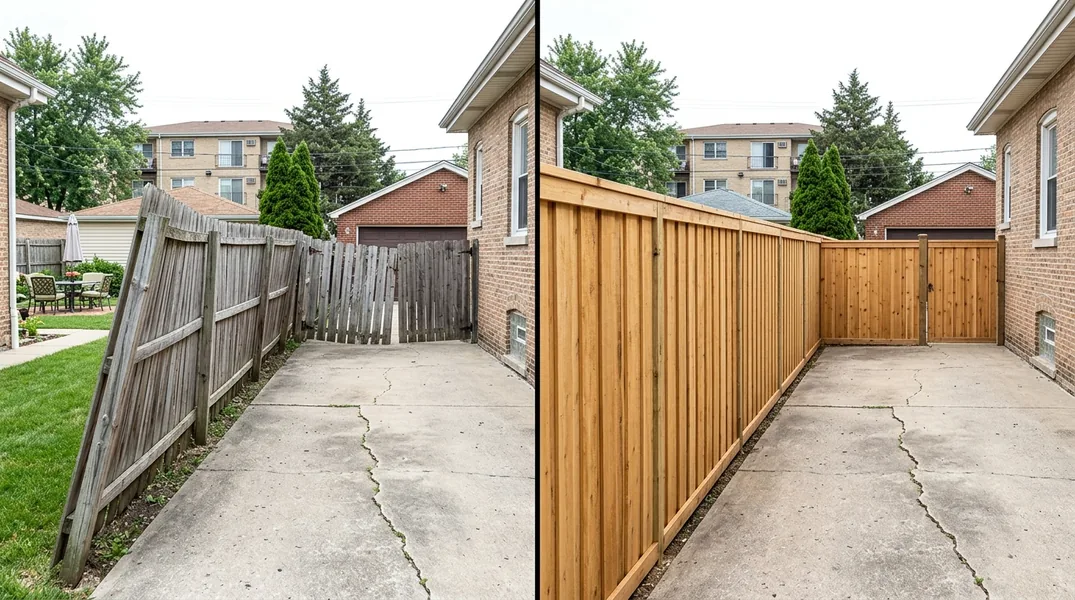
The height measurement is critical and must be taken consistently around the entire perimeter of your pool. Even if sections of your fence dip slightly due to ground slope, the barrier must maintain that 48-inch minimum height. Many homeowners in Chicago choose Wood & Privacy Fence Installation for their pool barriers because wood fences can be custom-built to maintain consistent height across uneven terrain. If your yard slopes or has grade changes, a professional fence contractor can ensure your barrier meets code while still looking attractive and maintaining proper drainage.
Gap and Spacing Regulations for Pool Fences
Beyond height, pool barrier code is very specific about gaps and spacing. Horizontal gaps (the space between horizontal rails or slats) cannot exceed 4 inches. This prevents small children from squeezing through or getting their heads stuck. Vertical gaps are equally important: the space between vertical slats or pickets cannot exceed 4 inches either. Additionally, the gap between the bottom of the fence and the ground cannot exceed 4 inches, which prevents children from crawling underneath.
These spacing requirements apply to the entire fence perimeter, including any gates. If you have an older fence with wider spacing, it may not meet current code. When planning a pool fence installation, work with experienced contractors who understand these specific measurements. Wood & Privacy Fence Installation is particularly effective for meeting gap requirements because wood slats can be precisely spaced and secured. Vinyl and composite materials also work well, and some homeowners opt for Chain Link Fence Installation with privacy slats to meet both the barrier requirements and aesthetic preferences.
Self-Closing Pool Gates and Self-Latching Requirements
One of the most important pool barrier code requirements is that all gates providing access to the pool must be self-closing and self-latching. A self-closing gate automatically swings shut after someone passes through it, while a self-latching gate automatically locks once it's fully closed. These features are essential safety measures because they ensure the pool remains enclosed even if someone forgets to close the gate manually.
The self-closing mechanism must function reliably in all weather conditions and should close the gate within 3 to 5 seconds of being opened. The latch must be positioned at least 54 inches above the ground (or 60 inches on the outside of the gate) so that young children cannot easily reach and open it. The latch must also require a deliberate action to open, not just a simple push. When you install a new pool fence, make sure your contractor provides gates that meet these specifications. Many pool gate manufacturers produce models specifically designed for code compliance, and a reputable fence company will know which ones are approved in Chicago.
If your current pool gate doesn't meet self-closing or self-latching requirements, this is a safety issue you should address immediately. Upgrading to compliant gates is often more affordable than replacing an entire fence, and it's a straightforward way to bring your pool into compliance. Some homeowners also add motion-sensing alarms to their gates as an additional safety layer, though this is not a code requirement.
Pool Fence Installation Near Me: Working with Chicago Professionals
Building or upgrading a pool fence to meet Chicago code requirements is a project best handled by experienced professionals who understand local regulations. When you hire a fence contractor, they should conduct a site inspection, measure your pool area, review current code requirements, and recommend materials and designs that meet all specifications while fitting your budget and aesthetic preferences.
Chicago Fence Pros specializes in pool barrier installation and understands the exact requirements for pools in Chicago and surrounding areas. Whether you need Wood & Privacy Fence Installation, vinyl options, or another material, we can design and install a fence that keeps your pool safe and compliant. Our team handles everything from initial design consultation through final installation, including proper gate setup with self-closing and self-latching mechanisms. If you're ready to upgrade your pool barrier, reach out to us at (872) 259-5832 or request a free estimate today.
Inspections and Compliance: What to Expect
After your pool fence is installed, the City of Chicago may require an inspection to verify compliance with pool barrier code. You'll typically need to contact the Department of Public Health or your local building department to request an inspection. The inspector will verify fence height, check spacing and gaps, test the self-closing and self-latching gate, and ensure the barrier completely encloses the pool area. Having a professional contractor handle the installation significantly increases the likelihood of passing inspection on the first attempt.
Maintaining your pool fence is also important for ongoing compliance. Over time, wood can warp, gaps may develop, or gates may become loose. Regular inspections of your barrier, especially before summer swimming season, help catch issues early. If you notice any damage or wear, contact your fence contractor promptly for repairs. A well-maintained pool fence protects your family, reduces liability risk, and ensures you remain compliant with local regulations.
Looking for a professional tree service in Chicago? Chicago Fence Pros responds fast for all your fence needs.
Get a Free Quote